
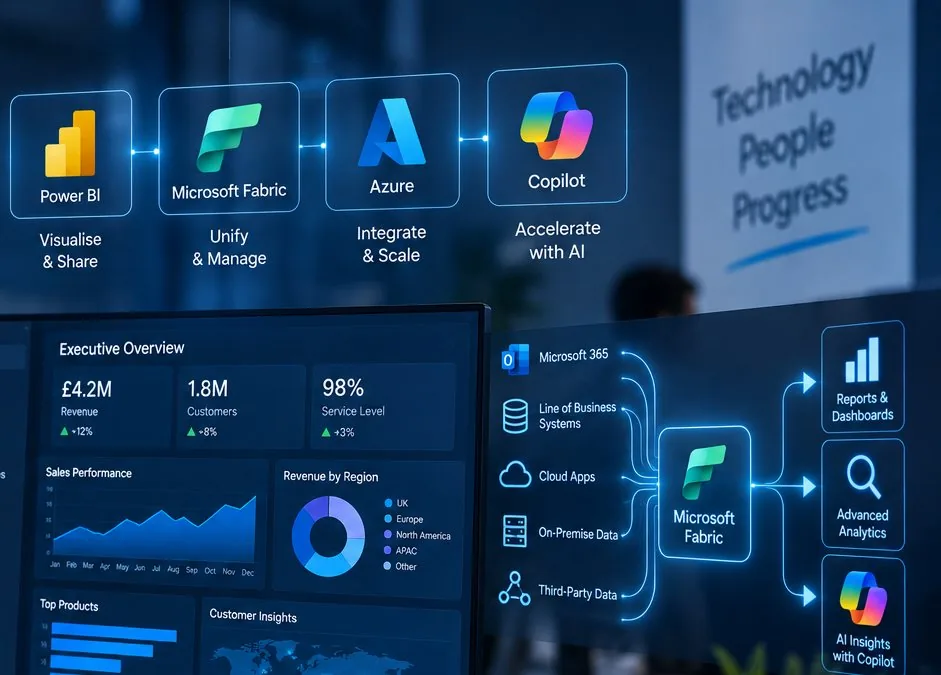
Data and AI services, starting from what you already have
Most organisations do not have a data problem. They have the same numbers in four places and no agreement about which is right.
Logic Networks helps organisations across London and the rest of the UK get their own information into a shape they can rely on, report from and, where it is genuinely useful, apply artificial intelligence to.
We start with reporting rather than with anything clever, because a management report that everybody trusts changes decisions immediately, and because the work needed to produce one is the same work any later project would need anyway.
We will also tell you when a tool you already pay for will do the job. That happens more often than the market suggests.
Artificial intelligence applied to untidy data produces confident answers that are wrong.
The order matters. Get the numbers agreed, then automate the reporting, then consider what a model could add on top of it.
- One agreed source for each number
- Reports that build themselves rather than being assembled by hand
- Artificial intelligence used where it earns its cost, not everywhere
- Your data staying yours, with the rules written down
What is included
Six pieces of work, in the order we would normally do them.
Most organisations stop after the third, and that is a sensible place to stop. The later pieces are worth doing only once the earlier ones are solid.
Finding out what data you hold
Including the spreadsheets nobody mentions.
A list of the systems and spreadsheets your information actually lives in, who maintains each one and where the same figure appears twice.
The finance system, the client database and somebody’s spreadsheet usually disagree. Knowing which is authoritative for each figure is the first decision, and it is a management decision rather than a technical one.
Tidying and joining it up
The dull work that makes the rest possible.
Duplicate records merged, formats made consistent, and the connections built so information moves between systems instead of being copied by hand.
This is the least interesting part of the work and it is where the value is. Every hour somebody spends retyping figures between two systems is an hour and a mistake.
Reporting and dashboards
A report a board will actually read.
Reports that refresh themselves, with each figure defined in writing so two people reading it reach the same conclusion.
We aim for one page that answers the questions your leadership actually asks, rather than a dashboard with forty measures that nobody opens after the second month.
Artificial intelligence where it pays
Applied to a named task, not in general.
The uses that are reliable today are narrow and useful: reading information out of documents, summarising long material, drafting a first version, and sorting incoming items into categories.
Each of those replaces a specific repetitive task and can be measured. We scope it to one task, measure the result and only then look at the next one.
Rules for using it safely
Written before somebody pastes a client file into a chatbot.
A short policy on which tools staff may use, what may never be put into them, and where the organisation’s own information is allowed to go.
Your staff are already using these tools. A policy written now is a policy; written after an incident it is a disciplinary matter. It needs to be one page and it needs to be explained rather than circulated.
Governance and the questions you will be asked
Answers ready for clients and funders.
What you hold, why you hold it, how long you keep it and who can reach it, recorded so that a client, a funder or a regulator’s question has an answer.
This overlaps with data protection duties you already have. We help with the technical side of it and will say plainly where you need proper legal advice instead.
How it works
Three arrangements, and the smallest one is where we would start.
Data projects fail by being too large. One report, built properly, teaches everybody more about the organisation’s information than a twelve month programme.
Tell us the question your leadership keeps asking and cannot answer quickly. That is usually the right first project.
-
One report, built properly
A single question answered with agreed definitions and an automatic refresh. Small, quick and immediately useful.
-
A data review
What you hold, where it disagrees with itself, what could be joined up and what it would cost. Written up in priority order.
-
Ongoing work
Reporting maintained and extended as part of managed IT, with the definitions kept current as the organisation changes.
Who it is for
This work suits organisations at the point where somebody is spending several days a month assembling a report by hand, or where two departments bring different numbers to the same meeting.
It also suits anybody being asked for information they hold but cannot easily produce.
- Businesses where the monthly pack takes somebody a week to build
- Charities and non profits reporting outcomes to funders
- Education organisations pulling together data for governors or inspection
- Organisations where two systems hold the same customer and disagree
- Teams whose staff have already started using artificial intelligence tools unofficially
- Anyone who has been asked what data they hold and could not answer
What we need from you
Three things, and the first one cannot be delegated to us.
We can build any report. What we cannot do is decide which number is the right one when two systems disagree.
Someone who owns the definitions
A person who can rule that a customer means this and a completed job means that. Without it, every report ends in an argument rather than a decision.
Access to the systems
Read access to the sources, and permission from the supplier where a system is somebody else’s. Some suppliers charge for this, and it is better to find out early.
The question, not the wish
Not a request for a dashboard, but the actual question somebody wants answered on a Monday morning. Everything else follows from it.
What we usually find in a data review
None of these is unusual, and all of them are worth knowing about before a project rather than during one.
- The same figure produced three ways, all slightly different
- A critical report that only one person knows how to build
- Records duplicated because two teams entered them separately
- A system holding data nobody has looked at for years
- Personal data kept far longer than any rule requires
- Information copied by hand between two systems every week
- Staff already using artificial intelligence tools with no guidance at all
- No written definition of the organisation’s most quoted number
Our steps for working together
We work in small pieces with something usable at the end of each. A data project with nothing to show for six months is a data project that gets cancelled.
- Pick one question The one somebody asks every month and nobody can answer in an afternoon.
- Agree the definitions What each term in that question means, written down and signed off by the person who owns it.
- Find the authoritative source For each figure, which system is right. Where two disagree, that is a decision to make, not a bug to fix.
- Build it and check it by hand The first version is compared against a manual calculation. If they differ, we find out why before showing anybody.
- Automate the refresh So the report exists on Monday without anybody assembling it.
- Use it for a month Then change it. The second version is the one people rely on.
- Pick the next question Reusing the connections and definitions already built, which is why the second project is always faster.
How we set priorities
Anything that somebody is currently doing by hand every week comes first, because the saving is immediate and measurable. Then anything a funder, client or regulator has asked for. Anything described as interesting comes last, however interesting it is.
Where artificial intelligence is reliable today, and where it is not
- Reliable: pulling information out of documents Invoices, forms and letters into structured fields, with a person checking the exceptions.
- Reliable: summarising and drafting A first version of a long document or a reply, edited by the person who sends it.
- Reliable: sorting incoming items Enquiries or requests routed into categories, with a fallback for anything unclear.
- Not reliable: numbers Anything where the figure has to be exactly right belongs in a report, not in a model.
- Not reliable: decisions about people Recruitment, eligibility and assessment carry legal duties and should not be automated on the quiet.
- Not reliable: anything nobody checks A confident wrong answer that goes straight out is worse than no answer at all.
The one page policy your staff need this month
Your people are already using artificial intelligence tools, whether or not anybody has approved them. The useful response is not a ban, because a ban moves the activity onto personal accounts where you can see none of it.
What works is a single page that answers five questions, written in plain words and explained in a team meeting rather than circulated as an attachment.
- Which tools are approved Named, with a route for asking about a new one.
- What must never be put in Client and staff personal details, anything under a confidentiality agreement, passwords, and unpublished financial information.
- What must be checked Anything that leaves the organisation, and anything containing a figure or a name.
- What must be disclosed Where a client or a funder needs to know that a tool was used.
- Who to ask A person, not a mailbox, for the cases the page does not cover.
We help write it, and we set up the approved tools so that your organisation’s data is handled under a business agreement rather than under a free consumer account. That second part is the one most organisations miss, and it is the one that matters legally.
What we will not claim
We will not promise a transformation from a dashboard. Reporting changes decisions only where somebody was already going to decide, and artificial intelligence saves time only on tasks that were genuinely repetitive. We will tell you when the honest answer is that the saving would be smaller than the cost of building it.
What good looks like
Two departments bring the same number to the same meeting. The monthly report appears without anybody building it. Every quoted figure has a written definition. Staff know which tools they may use and what they must not put into them. And where artificial intelligence is in use, somebody can say which task it does and how much time it saves.
Related services
Data work depends on the systems underneath being in order, so it tends to follow rather than precede the pieces below.
Where you already have a reporting tool, we build in it rather than proposing another one.
- Automation for the steps between systems that people currently do by hand
- Microsoft 365 because much of your information already lives there
- Cloud and Azure for where reporting and models are run
- Cybersecurity for who can reach the data and how it is protected
- Digital transformation if this is part of a larger change
Articles and news on data and artificial intelligence
Notes on reporting, definitions and where these tools are actually reliable, without the hype.
SharePoint or a mapped drive: choosing where files live
Neither option is the modern one and the old one. They are good at different things. Here are the questions that decide it.
Read the articlePlanning a hardware refresh over three years
Replacing everything at once is expensive and disruptive. A rolling three year plan spreads both, and the list is easier to build than it looks.
Read the articleWhat a monthly IT report should actually tell you
Ticket counts make a report look busy without saying whether anything improved. Here are the five things a monthly IT report should carry.
Read the articleTalk to us about data and artificial intelligence
Tell us the question your leadership keeps asking and cannot answer quickly. We will look at where the answer lives today and come back with what it would take to produce it automatically.
No obligation, and no sales call unless you ask for one.